Mar. 03, 2026
This technical analysis explores the divergent roles of galvanized and black malleable iron pipe fittings in modern infrastructure. Both fittings share a foundational metallurgy, undergoing a 96-hour annealing process to achieve the ductility required for high-pressure 2.5 MPa service and precision 1:16 taper threading. However, the Hot-Dip Galvanizing (HDG) process—submerging iron in 450°C molten zinc—creates a multi-layered metallurgical shield that protects against oxygenated water and atmospheric corrosion. In contrast, black iron fittings utilize a temporary oil or lacquer coating, making them the preferred, cost-effective choice for closed-loop systems like natural gas, propane, and high-temperature steam where oxygen is absent. This guide details why the "Zinc Flake" phenomenon makes galvanized fittings dangerous for gas lines, how the "Sacrificial Anode" effect of zinc extends the life-cycle of water systems, and the critical installation nuances required to achieve a leak-free interference fit in both varieties.
The Coating Contrast: Galvanized fittings feature a thick, chemically bonded zinc-iron alloy for permanent corrosion resistance; black fittings feature a temporary varnish designed for dry, oxygen-free environments.
Fluid-Specific Logic: * Galvanized: Mandatory for potable water, fire fighting pipe fitting networks, and outdoor exposure.
Black Iron: The industry standard for natural gas, oil, and low-oxygen steam heat.
The 1:16 Taper & Seal: Both fittings utilize a 1.7899° taper, but galvanized threads require significantly more lubrication (PTFE tape + pipe dope) to prevent "galling" caused by the sticky nature of zinc during high-torque assembly.
Hydraulic Calculation: When calculating system resistance, both types use the equivalent length formula: L_eq = (L/D) * D_internal
Safety & Compliance: Never use galvanized fittings in gas lines. The zinc coating can "spall" (flake off), traveling downstream to clog burners and pilot orifices—a critical safety risk in 2.5 MPa gas manifolds.
Corrosion Mechanics: Galvanized fittings act as a sacrificial anode, protecting the iron even if the surface is scratched. Black iron is prone to pitting corrosion in water lines, which can lead to localized wall failure under constant pressure.
Economic Longevity: While the initial cost of a gi pipe fitting is 20%–30% higher, its superior Life-Cycle Cost (LCC) in water systems eliminates the need for expensive "re-pipe" projects necessitated by rusted black iron.
At their core, black and galvanized fittings are "genetic" brothers. In the 2026 manufacturing landscape, both begin their lives in the same foundry as high-grade malleable iron. Before they receive their distinct finishes, they undergo the same rigorous 96-hour annealing process. This heat treatment is what transforms brittle cast iron into a ductile material capable of withstanding the 2.5 MPa pressures required for modern industrial infrastructure. Without this shared foundation, neither could handle the mechanical stress of a 1:16 taper interference fit.
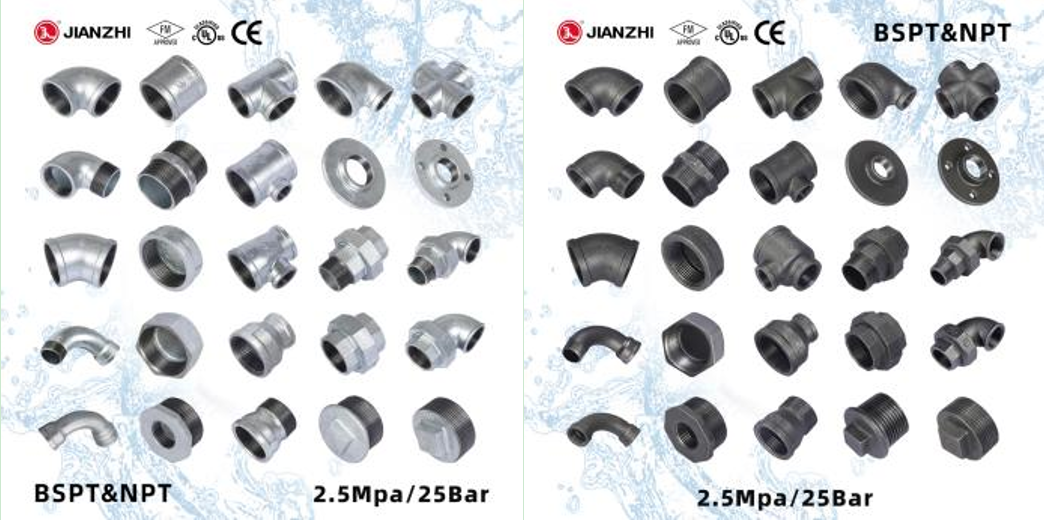
Pipe fitting illustration
The transformation into a galvanized pipe fitting is a violent, high-temperature chemical event. After the malleable iron is cleaned through an acid-pickling bath, it is submerged in a vat of molten zinc at approximately 450°C.
The Metallurgical Bond: This is not a surface paint. The zinc doesn't just sit on the iron; it reacts with it to form a series of zinc-iron alloy layers, topped with a final layer of pure zinc.
The "Self-Healing" Property: In 2026, the value of HDG lies in its sacrificial nature. If the fitting is scratched during installation with a heavy pipe wrench, the surrounding zinc will electrochemically protect the exposed iron, preventing rust from spreading. This is the "shield" that makes it the default for open-loop water systems.
The "black" in a black pipe fitting is actually a dark iron-oxide scale formed during the casting and cooling process.
The Coating: To prevent the fitting from "flash-rusting" (rusting immediately upon contact with humid air) during shipping and storage, it is typically dipped in a light protective oil or a thin, water-based black lacquer.
The Purpose: Unlike the galvanized shield, this coating is temporary. It is designed to be a "primer" or a placeholder. Once installed in a closed-loop gas or oil system where oxygen is absent, the fluid itself often provides the internal corrosion protection.
To the naked eye, the difference is immediate:
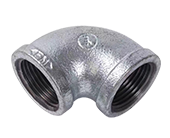
Galvanized: Appears silver, bright grey, or sometimes has a "spangled" crystalline texture. It feels slightly "rougher" to the touch due to the thickness of the zinc.
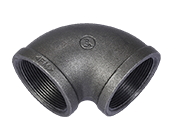
Black: Appears matte black or dark charcoal. It often feels slightly oily or waxy because of its protective varnish.
In a 2.5 MPa environment, weight can also be a subtle tell; a galvanized fitting is marginally heavier (roughly 3–5%) than its black counterpart due to the added mass of the zinc armor. Whether you are choosing a Jianzhi silver elbow or a black tee, the underlying strength remains identical, but their "armor" dictates where they can safely work.
In the plumbing and industrial world of 2026, putting the right fitting on the wrong pipe is a recipe for a maintenance nightmare. While both types of malleable iron pipe fitting can handle a 2.5 MPa load, the chemistry of the fluid inside determines which finish will survive. If you treat them as interchangeable, you’re essentially gambling with the structural integrity of your system.
A gi pipe fitting (galvanized iron) is the undisputed champion of water-carrying systems. Because water contains dissolved oxygen, raw iron will begin to oxidize (rust) almost immediately upon contact.
Potable Water: The zinc coating provides a non-toxic barrier that keeps drinking water clear of rust particles.
Fire Suppression: In a fire fighting pipe fitting network, pipes often sit stagnant for years. Galvanized fittings prevent internal "pitting" that could lead to a pinhole leak right when the system needs to maintain its 2.5 MPa pressure during an emergency.
Outdoor Environments: If your piping is exposed to rain, salt air, or soil moisture, the "sacrificial" zinc layer is the only thing standing between your threads and total seizure.
Black iron fittings are the industry standard for transporting "dry" or "non-corrosive" fluids.
Natural Gas and Propane: Gas lines are closed systems with almost zero oxygen. In this environment, black iron is perfectly stable and significantly cheaper than galvanized.
Steam and Hot Water Heat: In "closed-loop" heating systems, the water is treated to remove oxygen. Without oxygen, a black malleable iron pipe fitting can last for 50+ years without a hint of internal corrosion.
There is one cardinal rule in 2026 engineering: Never use galvanized fittings for gas lines. Over time, the gas—or the trace amounts of moisture and chemicals within it—can cause the zinc coating to "spall" or flake off the interior of the gi pipe fitting. These tiny silver shards travel downstream and clog the sensitive pilot lights, burners, and narrow orifices of expensive gas appliances. If you’re installing a 2.5 MPa gas manifold, black iron isn't just the cheaper choice; it's the only safe one.
If you use black iron for a water line, your water will turn orange within weeks as the fitting bleeds rust into the flow. Conversely, if you use galvanized for a high-temperature steam line, the "galvanic reversal" phenomenon can actually accelerate corrosion once temperatures exceed 60°C. For the 2026 professional, the logic is simple: Water and Weather = Galvanized; Gas and Heat = Black.
The mechanical heart of any 2.5 MPa system is the threaded connection. While both black and galvanized fittings utilize the standard 1:16 taper (a slope of approximately 1.7899°), the presence of a zinc coating fundamentally changes how those threads interact during assembly. In 2026, failing to account for the "thickness" of the galvanized layer is the leading cause of either under-tightened leaks or over-torqued hub fractures.
A common question in the field is whether the 1:16 taper is cut before or after the fitting is galvanized.
The Standard Method: High-quality manufacturers like Jianzhi typically galvanize the raw casting first and then CNC-machine the threads. This ensures that the thread geometry is razor-sharp and adheres perfectly to the 1:16 ratio.
The Trade-off: This leaves the "valleys" of the threads as raw, ungalvanized iron. While this might seem like a weakness, the tight mechanical "interference fit" of the taper, combined with the right sealant, creates an anaerobic environment where oxygen cannot reach the metal to cause rust.
Zinc is a relatively soft, "sticky" metal compared to iron. When you tighten a gi pipe fitting onto a galvanized pipe, you are performing a zinc-on-zinc slide.
The Problem: At the high torque required for 2.5 MPa seals, the zinc layers can "gall" or cold-weld together. This creates massive friction that makes the installer think the joint is tight when, in reality, the threads haven't fully engaged.
The Solution: Galvanized threads require significantly more lubrication than black iron. This is why the "Double-Seal" method (Tape + Dope) is non-negotiable for GI. The PTFE tape acts as a high-pressure lubricant, allowing the 1:16 taper to slide into its final "wedge" position without seizing.
The choice of sealant often differs based on the fluid and the fitting finish:
For Black Iron (Gas/Oil): Since black iron is often used for gas, a dedicated "Gas-Rated" pipe dope is the standard. These dopes are designed to resist the chemical breakdown caused by hydrocarbons. Because black iron threads are "cleaner" (no zinc buildup), they often reach the required engagement depth with less effort.
For Galvanized (Water/Fire): Use a high-density, blue or pink PTFE tape. The extra thickness of the tape helps compensate for the slightly "looser" tolerances sometimes found in galvanized hubs where the zinc might have pooled slightly before the final thread cut.
In a black iron system, the threads are often "grippier," providing clear tactile feedback when the 1:16 taper has reached its limit. In a galvanized pipe fitting, the "slickness" of the zinc (once lubricated) can make it easy to accidentally over-torque.
To ensure a safe 2.5 MPa installation, always follow the Finger-Tight Plus (F.T.P.) rule, but be aware that a galvanized joint may require a half-turn more than a black iron joint to achieve the same mechanical "crush." If you are working on a fire fighting pipe fitting line, consistency across the manifold is key—any joint that feels "spongy" rather than "firm" at the end of the turn likely has zinc debris trapped in the threads.
In the engineering landscape of 2026, the "cost" of a piping system is no longer measured by the purchase price of the malleable iron pipe fitting, but by its Life-Cycle Cost (LCC). The fundamental difference in corrosion profiles between black and galvanized fittings determines whether a system will remain leak-free for 50 years or require a catastrophic mid-life replacement. Understanding the "Sacrificial Anode" effect is the key to mastering high-pressure 2.5 MPa longevity.
The primary advantage of a gi pipe fitting is a process called galvanic protection. Zinc is more "active" than iron on the galvanic scale. When moisture and oxygen (the ingredients for rust) attack the fitting, the zinc "sacrifices" itself, corroding slowly to protect the underlying malleable iron.
Self-Healing Threads: This is particularly critical at the 1:16 taper interface. Even if the threads are slightly nicked during a high-torque 2.5 MPa installation, the surrounding zinc creates a microscopic "protective field" that prevents rust from "creeping" under the coating.
White Rust vs. Red Rust: You may notice a white, powdery substance on older galvanized fittings. This is Zinc Oxide, a sign that the coating is doing its job. Unlike the red rust found on black iron, white rust is stable and does not structurally compromise the fitting for decades.
Black iron fittings rely entirely on the absence of oxygen for their survival. In a closed-loop gas or chilled-water system, they are virtually immortal. However, in an open-loop water system, black iron suffers from pitting corrosion.
→ The Mechanism: Rust doesn't form evenly. It attacks small, localized spots, creating deep "pits." Under a constant 2.5 MPa load, these pits act as stress concentrators. Eventually, a pit can bridge the entire wall thickness of the malleable iron pipe fitting, resulting in a high-pressure "pinhole" leak.
→ Tuberculation: In fire fighting pipe fitting networks made of black iron, rust can grow into large "tubercles" or mounds inside the pipe. These not only weaken the fitting but can break off and clog sprinkler heads during an emergency.
At 2.5 MPa, fluid velocity is a major factor. In a black iron elbow, the sheer force of the water can physically "strip" the protective iron-oxide scale, exposing fresh metal to oxygen and accelerating rust. This is known as Erosion-Corrosion.
The hard zinc-iron alloy layers of a galvanized pipe fitting are much more resistant to this mechanical "scrubbing," making them the only viable choice for high-pressure municipal water mains and industrial cooling lines where the fluid is constantly moving.
Modern building codes now emphasize "Permanent Infrastructure." Using a galvanized system for water may cost 20–30% more upfront, but when evaluated over a 50-year span, the LCC is significantly lower because it eliminates the labor-intensive "re-pipe" projects necessitated by rusted black iron. For any professional specifying Jianzhi fittings, the "Silver Shield" of galvanization is the ultimate insurance policy against the hidden costs of corrosion.
The final stage of any piping project is the transition from design to the job site. In 2026, where labor costs are at an all-time high, "getting it right the first time" is the only way to maintain profitability. Whether you are installing a high-pressure 2.5 MPa gas manifold or a residential fire fighting pipe fitting system, the final verification of your malleable iron pipe fitting selection can prevent catastrophic failures during the pressure test.
For field technicians and procurement officers, the choice between black and galvanized fittings can be distilled into three primary variables: Fluid, Environment, and Pressure.
Feature | Black Iron Fitting | Galvanized (GI) Fitting |
Primary Fluid | Natural Gas, Propane, Steam, Oil | Potable Water, Fire Water, Compressed Air |
Corrosion Resistance | Low (Requires oil/lacquer) | High (Sacrificial Zinc Shield) |
Typical Lifespan | 50+ Years (Closed-Loop) | 50+ Years (Open-Loop/Outdoor) |
Cost | Budget-Friendly | Premium (~20-30% higher) |
Critical Warning | Never use in water lines (rust) | Never use in gas lines (flaking) |
A common question on-site is whether a galvanized fitting can be screwed onto a black pipe (or vice versa).
The Rule: In 2026, mixing is generally discouraged but not always "illegal" by code, provided the fluid is non-corrosive (like gas).
The Danger: In a water-carrying system, mixing these metals creates a Galvanic Cell. Because the zinc on the gi pipe fitting is more active, it will sacrifice itself even faster to protect the adjacent black pipe. This leads to "accelerated localized corrosion" at the threads, which can compromise a 2.5 MPa seal in just a few years.
The Best Practice: Always match the fitting to the pipe material to ensure uniform thermal expansion and consistent corrosion resistance.
If you encounter a gas appliance that is underperforming—small flames or a "whistling" regulator—and you see galvanized fittings in the supply line, you likely have a Zinc Flake issue.
The Fix: You must decommission the line, replace the gi pipe fittings with black iron, and blow out the lines with compressed air to clear the silver debris from the appliance's internal filters and orifices.
Before the 2.5 MPa pressure test begins, perform a final visual walk-through. Look for the manufacturer's mark. Genuine Jianzhi fittings are cast with clear, raised lettering.
→ For Galvanized: Ensure the coating is smooth and free of "puddles" in the threads that could interfere with the 1:16 taper.
→ For Black: Ensure the protective oil hasn't been stripped away, leaving orange flash-rust before the system is even filled.
By adhering to these 2026 standards, you ensure that your choice of malleable iron pipe fitting isn't just a component, but a permanent part of the building's skeletal integrity.
SAFER
PRODUCT INFO
ABOUT JIANZHI
TECH DATA
Contact Us
E-mail: sales1@jianzhi-fitting.com
Tel: +86 15822792427
Office In Tianjin:
Heping District, Tianjin, China.
Production Base 1:
Chifeng, Inner Mongolia, China.
Production Base 2:
Tangshan City, Hebei Province, China.
Production Base 3:
Schelei Street,Baicoi City,Prahova County,Romania