Feb. 12, 2026
In the context of 2026 industrial fluid systems, the selection between a tee fitting and a Y fitting (Wye) is a critical engineering decision that dictates the hydraulic efficiency and longevity of a 2.5 MPa network. This guide examines the fundamental geometric differences—the 90-degree perpendicular branch of the tee versus the 45-degree swept entry of the Wye—and their subsequent impact on system performance. By utilizing the Equivalent Length (L/D) ratio, we demonstrate that Y fittings significantly reduce turbulence and pressure drop, offering a superior solution for high-velocity or energy-sensitive lines. Conversely, we highlight the spatial advantages of the malleable iron pipe fitting tee for compact manifolds and distribution drops. Finally, the guide addresses the mechanical stress profiles of both geometries, emphasizing how Jianzhi's precision 1:16 taper and "Heavy Type" reinforcement ensure structural integrity against erosion-corrosion and high-pressure surges in both galvanized and black iron configurations.
Directional Dynamics: Tees are the standard for 90-degree distribution and "drops," whereas Y fittings provide a 45-degree directional sweep ideal for merging flows and minimizing backflow.
Hydraulic Efficiency (L/D): The Y fitting is mathematically more efficient, with an equivalent length ratio (L/D) of approximately 15 to 20, compared to the tee’s much higher ratio of 60.
Formula: L_eq = (L/D) * D_internal
Turbulence Management: The 45-degree sweep of a gi pipe fitting Wye maintains laminar flow, reducing "Water Hammer" and protecting the internal zinc coating from the impingement erosion common in 90-degree tees.
Spatial Constraints: Tees are the "King of the Mechanical Room" due to their compact footprint, allowing for high-density manifold stacking that Y fittings cannot match.
Pressure Reliability: For 2.5 MPa service, both fittings must feature "Heavy Type" reinforcement at the intersection (the "crotch") to manage hoop stress and ensure the 1:16 taper seal remains airtight under vibration.
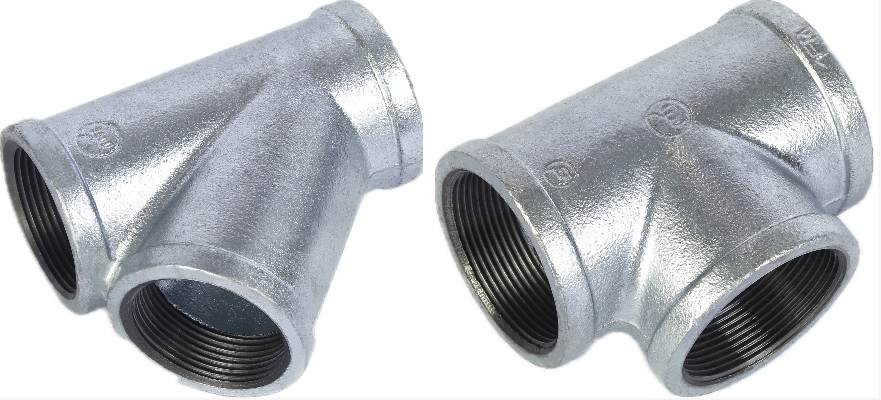
In the world of fluid infrastructure, the distinction between a tee fitting and a Y fitting (Wye) begins with the fundamental geometry of the intersection. These two components represent the two primary ways a fluid path can be diverted or merged within a malleable iron pipe fitting system. In 2026, as precision engineering becomes the standard for 2.5 MPa systems, understanding the mechanical "intent" of these shapes is the first step toward a successful installation.
The tee fitting is the most recognizable component in the piping family. It consists of a straight "run" and a single "branch" that intersects the run at exactly 90 degrees.
The "T" Profile: Because the branch is perpendicular, the tee is perfectly symmetrical. This makes it the ideal choice for distribution manifolds where water or gas needs to be dropped down to multiple units from a main overhead line.
Spatial Efficiency: The 90-degree intersection allows for extremely compact piping layouts. In tight mechanical rooms or within the walls of a high-rise, a tee allows the piping to hug the corners of the structural frame, minimizing the "footprint" of the utility.
A Y fitting, or Wye, features a branch that intersects the main run at a 45-degree angle. This creates a "swept" entry or exit.
The "Directional" Nature: Unlike a tee, a Wye is directional. It is designed to guide the fluid in a specific path, minimizing the sudden change in momentum that occurs at a 90-degree turn.
The "Y" Profile: Because of the 45-degree angle, the body of a Y fitting is physically longer than a standard tee. This means it requires more linear space along the pipe run, which can be a constraint in crowded industrial environments.
Regardless of the intersection angle, both the tee and the Y fitting rely on the 1:16 taper thread to maintain a seal at 2.5 MPa.
The Mechanical Challenge: In a 90-degree tee, the stress of the "wedge" effect is distributed evenly around the hub.
The Wye Challenge: In a Y fitting, the 45-degree intersection creates an asymmetrical "crotch" where the two cylinders meet.
Jianzhi utilizes CNC machining to ensure that the 1:16 taper is cut with absolute precision in both types. This ensures that even in the complex geometry of a Wye, the thread engagement is deep enough to prevent leaks under high-pressure surges. Whether you are using a gi pipe fitting for a cooling system or a black iron tee for a gas line, the geometric precision of the thread is what allows these different shapes to achieve the same pressure rating.
While geometry defines where the pipe goes, hydraulics defines how much it costs to get the fluid there. In a 2.5 MPa system, fluid velocity is often high, meaning every fitting acts as a "toll booth" that extracts energy from the flow in the form of pressure drop. The fundamental difference between a tee fitting and a Y fitting is the severity of this energy tax.
To compare fittings fairly, engineers use the concept of Equivalent Length. This allows us to treat a complex fitting as if it were a specific length of straight pipe. The relationship is defined by the L/D ratio, where L is the equivalent length and D is the internal diameter.
The formula to calculate the "frictional ghost pipe" added by a fitting is:
L_eq = (L/D) * D_internal
(Where L_eq is the equivalent length of straight pipe that would cause the same pressure drop as the fitting.)
For a standard malleable iron pipe fitting tee (where the flow enters the branch), the L/D ratio is typically around 60. In contrast, a 45-degree Y fitting (Wye) has an L/D ratio of approximately 15 to 20.
The practical result: A 90-degree tee creates three to four times more friction than a Y fitting. If you are running a high-capacity fire fighting pipe fitting line, using tees where Wyes could fit is like forcing your pumps to work against an extra several hundred meters of "imaginary" pipe.
The reason for this discrepancy lies in fluid momentum. When fluid hits a 90-degree tee branch, it essentially slams into a "wall" before being forced to pivot. This creates a massive Dead Zone or "recirculation bubble" just past the corner.
This turbulence does two things:
1. Energy Loss: It converts kinetic energy (pressure) into useless heat and noise.
2. Erosion-Corrosion: In a gi pipe fitting, this localized turbulence can physically "scrub" the protective zinc coating off the interior, leading to premature rusting.
The 45-degree sweep of a Y fitting allows the fluid to maintain more of its forward momentum. The transition is gradual, which keeps the flow "laminar" (smooth) rather than "turbulent" (chaotic). In industrial systems operating at 2.5 MPa, maintaining laminar flow is crucial for:
Reducing "Water Hammer": Smoother transitions mean less shock when valves open or close.
Lowering Pumping Costs: Less friction means your motors draw less electricity to maintain the same flow rate.
In short, if your project prioritizes energy efficiency or long-term durability against internal wear, the Y fitting is the superior hydraulic choice.
In the layout of an industrial piping network, the choice between a tee and a Y fitting often comes down to a battle between hydraulic ideal and spatial reality. While the Y fitting is superior for flow, the malleable iron pipe fitting tee remains the "King of the Mechanical Room" because of its unmatched spatial efficiency.
The primary reason a tee fitting is the standard in high-pressure 2.5 MPa distribution manifolds is its footprint. In a manifold, where a single main line might serve ten different branch lines, the perpendicular nature of the tee allows pipes to be stacked closely together.
Fire Sprinkler Drops: In a fire fighting pipe fitting system, tees are used for "drops" to individual sprinkler heads. Since these systems are often hidden behind ceiling tiles, the 90-degree turn allows the pipe to descend vertically in the shortest distance possible.
Structural Integration: Tees are far easier to brace against structural steel. Their symmetrical shape means that "hoop stress" and thermal expansion are predictable, making them the default for rigid building infrastructures.
While tees are great for distribution (splitting flow), Y fittings are the mandatory choice for merging (combining flow).
The "Backflow" Problem: When two fluid streams meet at a 90-degree angle in a tee, the turbulence creates a momentary "high-pressure wall" that can push fluid backward into the other branch. A Y fitting eliminates this by ensuring both streams are already traveling in the same general direction when they collide.
Slurry and Solids: In systems transporting anything other than pure liquid (such as sediment-heavy water or industrial slurries), a 90-degree tee is a clog waiting to happen. The 45-degree sweep of a gi pipe fitting Wye prevents solids from accumulating in the "dead zone" of the branch.
The biggest drawback of the Y fitting is its length. Because the branch extends at 45 degrees, the "run" of the fitting must be significantly longer to maintain structural integrity at 2.5 MPa.
The "Combo" Solution: In many 2026 installations, if a 45-degree angle is needed but the pipe must eventually turn 90 degrees, engineers use a Combination Wye and Eighth-Bend. This provides the hydraulic benefits of a Wye but eventually returns the pipe to a perpendicular path.
Selection Tip: If you have less than 30 cm of clearance between parallel lines, stick with a malleable iron tee. If you are merging two lines where the velocity exceeds 3 meters per second, a Y fitting is the only way to prevent destructive vibration.
Operating at a consistent pressure of 2.5 MPa puts a relentless mechanical burden on any piping system. At this pressure, every fitting isn't just a conduit; it's a pressure vessel. The mechanical difference between a tee fitting and a Y fitting lies in how they distribute this internal stress and how they resist the destructive forces of the fluid moving inside them.
In engineering terms, the most vulnerable part of any branch fitting is the "crotch"—the internal intersection where the branch meets the main run.
The Tee's Advantage: In a 90-degree malleable iron pipe fitting, the stress is distributed somewhat symmetrically. The "T" shape allows for a natural reinforcement ring to be cast around the entire intersection.
The Wye's Challenge: A Y fitting creates an acute angle. This "V" shape acts as a "stress riser." Under a 2.5 MPa load, the internal pressure tries to "unfold" the 45-degree angle, pushing the branch away from the run.
To combat this, Jianzhi’s "Heavy Type" fittings are engineered with increased wall thickness at these critical junctions. By using malleable iron with 10–12% elongation, the fitting can microscopically flex under pressure spikes rather than cracking like standard gray iron.
In a gi pipe fitting, the internal zinc coating is the first line of defense against rust. However, high-pressure flow (2.5 MPa) often carries high velocity.
Direct Impact in Tees: In a 90-degree tee, the fluid slams directly into the back wall of the fitting. This "impingement" can physically erode the zinc coating over time, exposing the raw iron to oxygenated water.
Glancing Impact in Wyes: Because the Y fitting has a 45-degree sweep, the fluid "glances" off the walls. This significantly reduces the rate of mechanical erosion, preserving the galvanized protection for a much longer service life.
The reliability of the 2.5 MPa seal depends on the 1:16 taper engagement. Because Y fittings are physically longer and asymmetrical, they are more susceptible to "bending moments" during installation. If an installer applies too much leverage to a long-branch Wye, they can actually distort the circularity of the hub, causing a leak.
Jianzhi’s CNC-machined threads ensure that the 1:16 taper is perfectly concentric to the hub axis. This precision ensures that even if the fitting experiences external vibration or thermal expansion, the metal-to-metal interference fit remains airtight. Whether you are choosing a tee for its compact strength or a Wye for its hydraulic kindness, the metallurgical quality of the malleable iron is what prevents a catastrophic hub split at peak pressure.
Choosing the right fitting isn't just about making the pipes connect; it’s about ensuring the system thrives under pressure. As we wrap up this guide for 2026's high-efficiency standards, the choice between a tee fitting and a Y fitting (Wye) comes down to a simple trade-off: Space vs. Flow.
To help your procurement or engineering team make the right call for a 2.5 MPa system, use this reference table:
Feature | Tee Fitting (90°) | Y Fitting (Wye 45°) |
Primary Function | Distribution & "Drops" | Merging & Diverting |
L/D Ratio | High (~60) | Low (~20) |
Turbulence | High (Significant) | Low (Laminar) |
Spatial Footprint | Compact / Space-saving | Large / Long run |
Best For | Fire Sprinklers, HVAC | Pumps, Slurries, Drains |
Mechanical Stress | Symmetrical / Stable | Asymmetrical / High "Crotch" Stress |
The most frequent mistake in 2026 is substituting a Sanitary Wye for a Pressure Wye.
The Error: Sanitary fittings are designed for gravity-fed waste systems and often have thinner walls.
The Danger: Using a thin-walled DWV (Drain, Waste, Vent) Y fitting in a 2.5 MPa fire line will result in a catastrophic burst.
The Solution: Always verify that your malleable iron pipe fitting is rated for pressure. Jianzhi fittings are specifically cast to handle the hoop stress of pressurized fluids, regardless of whether the shape is a tee or a wye.
If you hear a "thumping" or high-pitched whistle in your lines, you likely have a velocity issue at a 90-degree intersection.
Diagnosis: High-velocity fluid hitting the back of a gi pipe fitting tee creates cavitation.
Remedy: If space permits, replace the tee with a Y fitting and a 45-degree elbow. This "swept" transition reduces the noise and prevents the vibration from loosening your 1:16 taper joints over time.
For distribution in tight corridors, the malleable iron tee is your reliable workhorse. But for the main arteries of your system—where energy efficiency and pump longevity are the priorities—the Y fitting is the superior engineering choice. By selecting Jianzhi’s heavy-type fittings, you ensure that whichever geometry you choose, the material integrity will stand up to the rigorous demands of 2.5 MPa service.
SAFER
PRODUCT INFO
ABOUT JIANZHI
TECH DATA
Contact Us
E-mail: sales1@jianzhi-fitting.com
Tel: +86 15822792427
Office In Tianjin:
Heping District, Tianjin, China.
Production Base 1:
Chifeng, Inner Mongolia, China.
Production Base 2:
Tangshan City, Hebei Province, China.
Production Base 3:
Schelei Street,Baicoi City,Prahova County,Romania