Aug. 19, 2026
BSPT (British Standard Pipe Taper) and NPT (National Pipe Taper) are the world's dominant tapered thread standards for malleable iron fittings. BSPT uses a 55-degree thread angle; NPT uses 60 degrees. They are not interchangeable — mixing them risks leaks and failed pressure tests. This guide explains the differences and how to choose the right standard for your market.
Buying for a new market? Send an inquiry — Jianzhi produces BSPT and NPT threads in one factory, so a single supplier covers both.
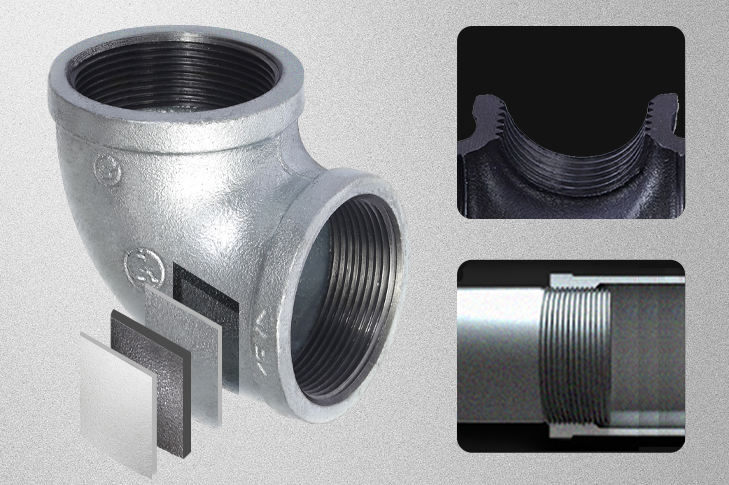
Pipe threads seal a connection under pressure by wedging metal against metal as the fitting tightens — and the two dominant standards were designed for different systems.
BSPT is the British Standard Pipe Taper thread, defined under ISO 7-1 / EN 10226 — dominant in Europe, the Middle East, the Commonwealth, and much of Southeast Asia.
NPT is the American National Pipe Taper thread, defined under ASME B1.20.1. It dominates North America and parts of Latin America.
For a global buyer, the question is not which thread is better — it is which standard your market's codes require. Buyers should also understand the wider requirements for pipe fitting standards and certification requirements before selecting threaded fittings for international projects.
| Parameter | Specification |
|---|---|
| Standard | EN10242 / ISO 49 (fitting body) |
| Thread Types | BSPT (ISO 7-1 / EN 10226), NPT (ASME B1.20.1) |
| Thread Angle | BSPT: 55° / NPT: 60° |
| Taper | 1:16 (both, measured differently) |
| Material | Malleable iron, annealed |
| Pressure Rating | 2.5 MPa (25 bar) |
| Tensile Strength | ≥350 MPa |
| Elongation | ≥10% |
| Finishes | Black, Hot-Dip Galvanized |
| Certifications | FM, UL, ABNT, SIRIM, ISO, and CUL certified |
| Testing | 100% air leak test per fitting |
The three numbers that decide which standard fits: 55° vs 60° angle, 1:16 taper, and pitch (TPI) per size.
For additional product specifications and sizing information, buyers can review our malleable iron pipe fitting technical data when preparing RFQs and project documentation.
No. They are not interchangeable — and this is the most expensive mistake a buyer can make. The reasons are geometric:
• Thread angle: 55° (BSPT) vs 60° (NPT) — a gauge tells the difference instantly.
• Pitch: For several nominal sizes, BSPT and NPT use different threads per inch — so the spiral rates do not match.
• Crest and root shape: NPT threads have flat crests and roots; profiles are machined to different tolerances.
An NPT male thread can occasionally be forced into a BSPT female fitting — but it will not seal. The mismatch shows up as leaks, cross-threading, or a fitting that jams after two turns — a field liability in fire protection, gas, or steam systems.
For a deeper technical comparison of sealing performance and installation risks, you can also read our BSPT vs NPT malleable iron fittings guide.
Use a thread pitch gauge or known-good sample: measure the flank angle (55° vs 60°) and count threads per inch against the chart. Spec the thread standard on the PO — never assume the factory will ship the right one.
When checking actual products, buyers should also confirm the required thread standard for their threaded malleable iron pipe fittings before ordering.
Choose by destination market, not preference:
• North America (US, Canada): NPT per ASME B1.20.1 — the norm for threaded piping, including fire protection.
• Europe, Middle East, Southeast Asia, UK & Commonwealth: BSPT per ISO 7-1 / EN 10226 — the standard for water, gas, and hydraulic systems.
• Brazil and parts of Latin America: both appear; gas and industrial lines commonly use NPT, while water and HVAC often use BSPT.
The safe strategy: buy a dual-thread line — BSPT for European/Middle East projects, NPT for American-standard ones — from one certified factory, keeping your stock book and compliance file simple.
For projects requiring American-standard connections, Jianzhi can also supply NPT threaded pipe fittings across different product sizes.
Sourcing for two regions? Send an inquiry — Jianzhi confirms availability of both BSPT and NPT across your size list.
If you are sourcing threaded fittings internationally, selecting the correct thread standard is only one part of the purchasing process. Read our guide on how to import malleable iron fittings from China to understand supplier certifications, MOQ requirements, and FCL/LCL logistics before placing your first order.
Threads carry the mechanical connection; certifications carry the legal one. Every destination market has an authority that audits fittings — and a matrix that proves the factory passed its tests.
| Certification | Coverage | What It Confirms |
|---|---|---|
| FM Approved | US / Global | Fire protection service + ongoing factory audits |
| UL Listed | US / Global | Fire safety and pressure testing |
| CUL | Canada | Canadian-spec listing (US tests, Canadian recognition) |
| ABNT | Brazil | Compliance with Brazilian structural standards (≥350 MPa tensile) |
| SIRIM | Malaysia | National standards approval for imported piping products |
| ISO 9001 / ISO 49 | Global | Quality management + dimensional standard compliance |
Before you order, ask for the certificate file numbers — then verify them online. A factory holding FM, UL, ABNT, SIRIM, ISO, and CUL certifications across one line has been audited by multiple authorities — the strongest due-diligence signal short of a site visit.
Buyers can also review available malleable iron fitting certificates when preparing supplier qualification and project compliance documents.
Need certificates for your market? Send an inquiry — Jianzhi provides certificate packs and MTRs for your compliance file.
For distributors, the thread question is really a stock-keeping question — and dual-thread supply from one factory changes the math.
• One factory, two thread lines: BSPT and NPT on the same certified line — no double vendor files.
• 44+ years of production experience: manufacturing malleable iron fittings at industrial scale since 1982.
• 400,000 m² manufacturing facility: China's largest cast iron pipe fitting factory, with stock capacity for mixed orders.
• EN10242 / ISO 49 backbone: international dimensional standard applied across both thread types.
• 100% air leak testing: every pressurized fitting individually tested before packing.
For a wholesaler: one PO, one compliance file covering two thread standards. For a contractor: the right thread for the project's code, certificates attached.
Buyers preparing product specifications can also access relevant technical data and product documentation to support RFQs, engineering reviews, and purchasing decisions.
Three decisions separate a smooth thread order from a costly one:
Confirm the thread standard — BSPT (ISO 7-1) or NPT (ASME B1.20.1) for every size on your list.
Verify the geometry — 55° vs 60° angle, pitch per size, before you commit to samples.
Check market certifications — FM/UL/CUL for the Americas, ABNT for Brazil, SIRIM for Malaysia, ISO across the board.
The fittings you specify today will be inspected by an AHJ tomorrow — specify threads that match the code.
For Wholesalers & Distributors — Send an inquiry for the Jianzhi dual-thread (BSPT + NPT) volume price sheet and mixed-container stocking program.
For EPC Contractors & Specifiers — Send an inquiry for MTRs, FM/UL/ABNT/SIRIM certificate packs, and thread-standard documentation for your project file.
To help our team respond faster, include in your inquiry: target markets, thread standard per size, and estimated annual volume.
SAFER
PRODUCT INFO
ABOUT JIANZHI
TECH DATA
Contact Us
E-mail: sales1@jianzhi-fitting.com
Tel: +86 15822792427
Office In Tianjin:
Heping District, Tianjin, China.
Production Base 1:
Chifeng, Inner Mongolia, China.
Production Base 2:
Tangshan City, Hebei Province, China.
Production Base 3:
Schelei Street,Baicoi City,Prahova County,Romania