Aug. 12, 2026
A leak at a threaded joint is never just a drip — in a gas line it is a safety hazard, in a water system it is rework, downtime, and a damaged reputation. The good news: leak-free connections follow one repeatable formula. Correct sealant + correct application + correct torque = a joint that holds. This guide covers how NPT and BSPT threads seal, when to use PTFE tape vs pipe dope, and how to test before you trust.
Selecting fittings for an upcoming project? Send an inquiry and our engineers will confirm thread type and pressure class for your specification — free of charge.
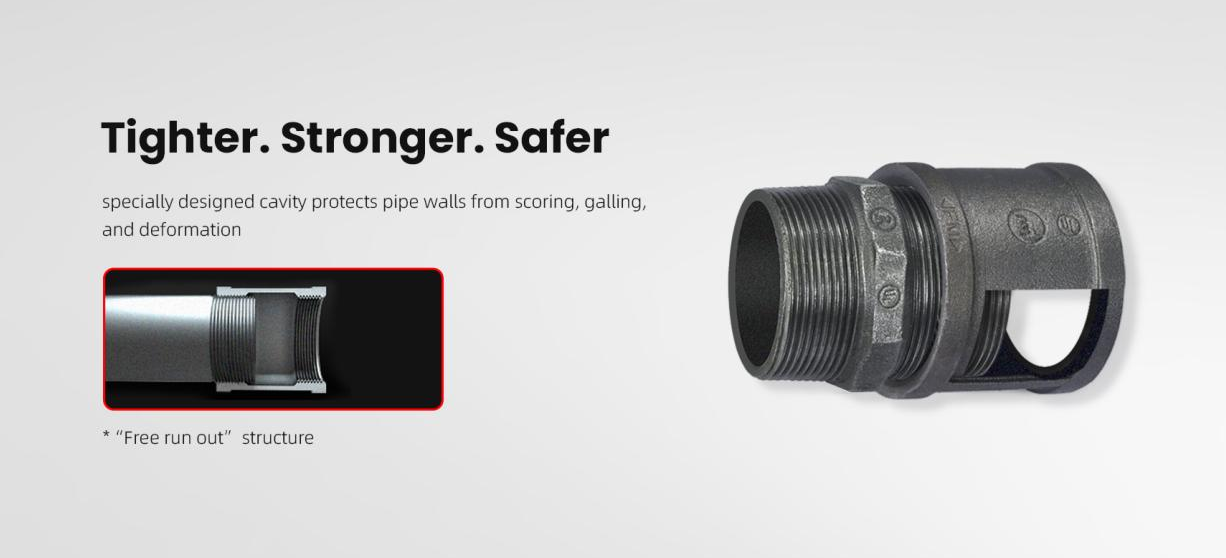
Threaded connections seal through two fundamentally different mechanisms. Understanding which one your fitting uses determines how you must seal it.
Parameter | NPT (ASME B1.20.1) | BSPT (EN10226) |
Thread Angle | 60° | 55° |
Taper | 1:16 | 1:16 |
Sealing Principle | Thread flank deformation | Thread flank deformation |
Common Markets | North America, Americas | Europe, Middle East, Asia |
Sealant Requirement | Tape / dope / both | Tape / dope / both |
Interchangeability | Not compatible with BSPT | Not compatible with NPT |
Both NPT threaded fittings and BSPT threaded fittings are taper threads: the diameter increases along the thread length, so tightening forces the flanks to deform against each other, creating a metal-to-metal interference seal. The sealant fills the microscopic spiral gap that remains.
Never mix NPT and BSPT fittings. The 5° thread-angle difference means they can be forced together but will not seal — a classic source of mystery leaks.
Three sealing approaches dominate the industry. Each has a place.
PTFE (Teflon) tape — the default for most water, air, and gas applications. Cheap, clean, and effective when applied correctly.
Pipe dope (thread sealant compound) — a paste or liquid that fills thread voids. Preferred for high-pressure systems and metal-on-metal applications where tape can shear.
Tape + dope combination — controversial, but justified in high-pressure gas and steam service where redundancy reduces risk.
The most common installation question, and the source of most tape-related leaks:
Clean the male threads — remove dirt, oil, and old tape residue.
Start one thread back — leave the first two threads bare so tape can't shred into the pipe.
Wrap clockwise — as viewed from the end of the fitting, so tightening pulls the tape tighter instead of unwinding it.
Apply 3–5 wraps for NPT/BSPT (1/2 to 2 sizes). More than 5 wraps increases the risk of the tape bunching and causing a false seal that fails under pressure.
Press the tape into the thread root — a light stretch while wrapping embeds it into the grooves.
Yes, for high-stakes joints — with one rule: tape first, dope on top, never on the female threads. The tape provides the bulk and lubricant, the dope fills any remaining spiral gaps. For standard water and low-pressure air lines, one method is sufficient. For natural gas, propane, steam, or anything above 150 psi working pressure, the combination is the safer call.
Experiencing repeated leaks with your current supplier's fittings? Request free samples from Jianzhi and run a thread-quality comparison test against your existing stock — measure the difference yourself.
Sealant cannot compensate for poor tightening. Torque matters because it drives the thread interference that creates the seal.
1/2 fittings: 3 turns past hand-tight
3/4 fittings: 3 turns past hand-tight
1 fittings: 2–3 turns past hand-tight
1-1/4 and larger: 2 turns past hand-tight
Over-tightening is the hidden killer. Excessive torque can crack a Class 150 malleable iron fitting or distort the thread profile, converting a good joint into a guaranteed future leak. When the fitting stops turning smoothly and resistance builds, stop — do not give it one more turn.
Dry test — pressurize the system with air to the working pressure and check every joint with soapy water.
Hydrostatic test — fill with water and pressurize to 1.5× working pressure for a minimum of 30 minutes.
Inspect, don't just listen — small leaks hiss; slow weeps need a visual check with a soap solution.
Need the complete torque table and pressure-testing specification sheet? Send an inquiry to request the Jianzhi technical documentation pack — free for engineers and contractors.
No amount of tape or torque fixes a poorly cut thread. Thread geometry — taper accuracy, flank angle, and surface finish — is determined at the factory, and it is the single biggest variable in field leak rates.
EN10242 manufacturing standard — every threaded malleable iron fitting is produced to a European standard that governs thread dimensions and tolerances, not just material grade.
44+ years of production experience — thread-cutting expertise accumulated since 1982, across billions of elbows, tees, couplings, and unions shipped worldwide.
400,000 m² manufacturing facility — China's largest cast iron pipe fitting factory, with in-house thread gauging and statistical process control on every production line.
Six international certifications: FM, UL, ISO 9001, ABNT, SIRIM, and CUL — third-party verification that the quality system behind the threads is audited, not claimed.
A consistent, precisely machined thread means the installer needs less sealant, less torque, and fewer callbacks. That is the factory-level difference behind your field failure rate.
Planning a bulk purchase? In your inquiry, request the factory audit report and third-party thread inspection certificates alongside your quote — Jianzhi provides them with every volume order.
Run this checklist before every threaded joint and your leak rate will drop to near zero:
Inspect the threads — reject fittings with damaged, chipped, or inconsistent threads.
Match the thread standard — NPT to NPT, BSPT to BSPT. Never mix.
Select the sealant for the service — tape for standard water/air; tape + dope for gas, steam, and high pressure.
Apply correctly — clockwise, 3–5 wraps, starting one thread back, never on female threads.
Tighten to feel, test under pressure — stop at resistance, then hydrostatic test at 1.5× working pressure.
For EPC Contractors & Installers — Send an inquiry for the installation technical pack: torque tables, pressure-testing specs, MTRs, and free sample fittings for thread-quality comparison.
For Wholesalers & Distributors — Send an inquiry for the Jianzhi volume price sheet, full certification pack (FM, UL, ISO 9001, ABNT, SIRIM, CUL), and lead-time options for stocking programs.
To help our engineers respond faster, include in your inquiry: fitting specifications, target market, and estimated annual volume.
SAFER
PRODUCT INFO
ABOUT JIANZHI
TECH DATA
Contact Us
E-mail: sales1@jianzhi-fitting.com
Tel: +86 15822792427
Office In Tianjin:
Heping District, Tianjin, China.
Production Base 1:
Chifeng, Inner Mongolia, China.
Production Base 2:
Tangshan City, Hebei Province, China.
Production Base 3:
Schelei Street,Baicoi City,Prahova County,Romania