Apr. 15, 2026
Fire protection piping systems must perform flawlessly under extreme conditions. However, rigid piping alone cannot handle thermal expansion, vibration, or structural movement.
This is where flexible couplings play a critical role. They allow controlled movement within the system while maintaining a secure, leak-proof connection.
Choosing the right flexible coupling is not just a technical decision—it directly impacts system reliability, safety compliance, and long-term performance.
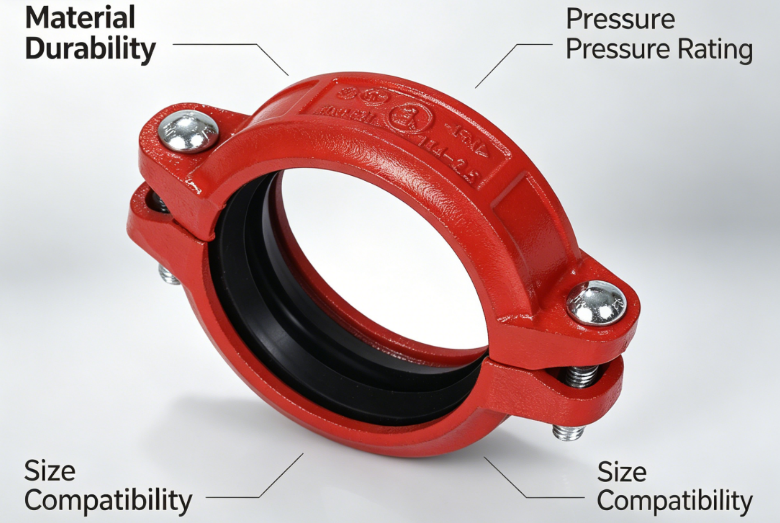
Flexible couplings absorb vibration, thermal expansion, and seismic movement
UL/FM certification is essential for fire protection systems
Correct pressure rating and gasket material ensure long-term reliability
Strategic placement improves system performance and safety
Flexible couplings are designed to allow:
Axial movement (pipe expansion and contraction)
Angular deflection (misalignment tolerance)
Vibration damping (especially near pumps)
Unlike rigid couplings, they create a dynamic joint that absorbs stress instead of transferring it.
Learn more about the working principle in our guide:
How Flexible Couplings Work in Fire Protection Systems
Always match the coupling rating with system pressure.
Standard: 300 PSI
Heavy-duty: 500 PSI+
High-rise and industrial systems typically require higher ratings.
EPDM (Grade E) is widely used because it:
Handles -34°C to +110°C
Works well with water-based fire systems
For chemical additives, always confirm compatibility.
Choose coating based on environment:
Indoor: standard painted
Outdoor: hot-dip galvanized
Coastal/industrial: enhanced anti-corrosion coating
Ensure the coupling matches:
Pipe schedule (Sch 10 / Sch 40)
Groove type (roll or cut)
Improper fit leads to leaks or reduced flexibility.
UL and FM certifications ensure:
High-pressure resistance
Long-term durability
Compliance with fire safety standards
Read detailed comparison:
UL vs FM Approved Couplings: What’s the Difference?
Flexible couplings are critical in:
Fire pump rooms
Vertical risers
Long pipeline runs
Seismic zones
Explore full applications:
Where Are Flexible Couplings Used in Fire Protection Systems?
Improper installation can cause system failure.
See full guide:
5 Common Mistakes When Installing Grooved Couplings
Choosing the right flexible coupling ensures your fire protection system can withstand pressure, movement, and time.
A well-designed system combines:
Correct product selection
Certified components
Proper installation
Looking for UL/FM approved flexible couplings for your project?
Contact JIANZHI today for technical support, catalogs, and samples.
SAFER
PRODUCT INFO
ABOUT JIANZHI
TECH DATA
Contact Us
E-mail: sales1@jianzhi-fitting.com
Tel: +86 15822792427
Office In Tianjin:
Heping District, Tianjin, China.
Production Base 1:
Chifeng, Inner Mongolia, China.
Production Base 2:
Tangshan City, Hebei Province, China.
Production Base 3:
Schelei Street,Baicoi City,Prahova County,Romania