Apr. 17, 2026
Flexible couplings are not meant to be used everywhere in a fire protection piping system—they are designed to be used strategically.
Their primary function is to absorb movement and reduce stress in areas where rigid piping would otherwise fail. Understanding where to use them is critical for both system performance and long-term reliability.
Flexible couplings are essential in high-vibration and high-movement areas
They protect piping systems from thermal expansion, vibration, and seismic forces
Proper placement significantly improves system lifespan and reliability
Incorrect usage can lead to leaks, fatigue, and system failure
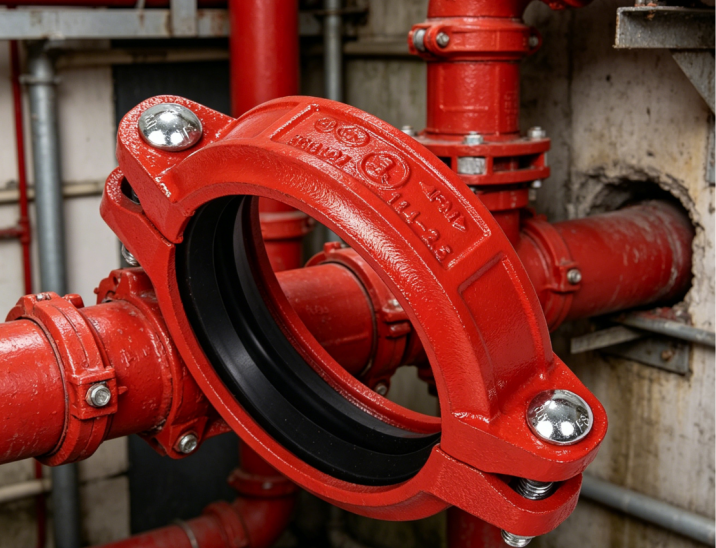
Fire pumps generate continuous vibration and hydraulic shock during operation. If this energy is transmitted through rigid piping, it can lead to:
Loosened joints
Metal fatigue
Premature system failure
Without flexible couplings:
Vibrations travel through the entire system
Increased maintenance costs
Higher risk of leakage
Pump suction line
Pump discharge line
Near valves and flow meters
In multi-story buildings, vertical pipes expand and contract due to temperature changes.
Pipe stress at floor penetrations
Structural damage
Misalignment over time
Install flexible couplings at intervals (e.g., every few floors) to allow controlled movement.
Long pipe runs accumulate thermal stress.
Flexible couplings allow:
Controlled axial movement
Reduced stress on hangers and supports
In earthquake-prone regions, rigid systems can fail instantly.
Allow angular deflection
Absorb building movement
Maintain water supply during emergencies
Where pipelines cross structural joints:
Buildings move independently
Pipes must accommodate multi-directional shifts
Flexible couplings are often installed in loop configurations to handle this.
Scenario | Flexible Coupling | Rigid Coupling |
Pump room | Required | Not recommended |
Risers | Recommended | Limited |
Seismic zones | Critical | Unsafe |
Straight stable runs | Optional | Preferred |
Combine flexible and rigid couplings strategically
Avoid overusing flexible couplings in load-bearing sections
Ensure proper spacing and support design
Follow system engineering drawings
Learn how to select the right coupling:Flexible Coupling Selection Guide
Flexible couplings are not just components—they are strategic tools in system design. Proper placement ensures that your fire protection piping system can withstand vibration, movement, and real-world stress.
Need help choosing the right coupling layout for your project?
Contact JIANZHI for expert engineering support and certified products.
SAFER
PRODUCT INFO
ABOUT JIANZHI
TECH DATA
Contact Us
E-mail: sales1@jianzhi-fitting.com
Tel: +86 15822792427
Office In Tianjin:
Heping District, Tianjin, China.
Production Base 1:
Chifeng, Inner Mongolia, China.
Production Base 2:
Tangshan City, Hebei Province, China.
Production Base 3:
Schelei Street,Baicoi City,Prahova County,Romania