Jul. 08, 2026
If you have ever needed to service a industrial pump, replace a clogged flow meter, or isolate a boiler line, you know why pipe unions exist. Unlike standard threaded couplings that lock a piping run permanently, a union allows pipe fitters to break a line and put it back together without cutting pipe or backing off long threaded runs.
However, not all malleable iron unions handle repeated servicing equally. In high-pressure water, steam, and HVAC circuits, standard iron-to-iron seats frequently leak after being uncoupled.
Upgrading to brass seat malleable iron unions solves this issue by inserting a precision-machined brass ring into the seating interface, creating a reliable, reusable metal-to-brass seal that withstands heavy wrenching.
Under the premier Jianzhi brand—backed by 44 years of specialized casting and machining experience—our brass seat unions are engineered to deliver zero-leak seals across industrial and commercial fluid networks.
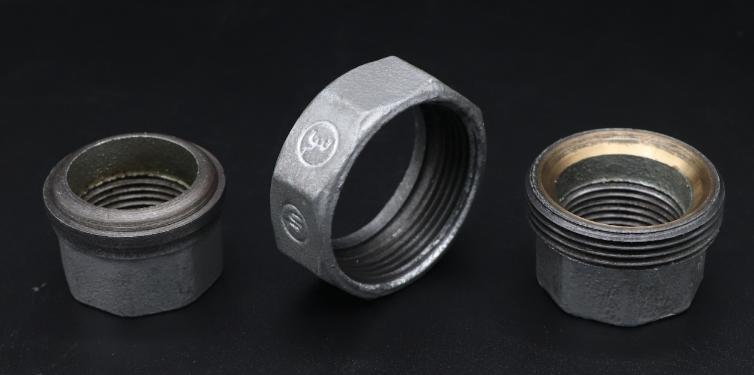
Precision Engineering: Jianzhi Heavy-Duty Brass Seat Malleable Iron Unions
A pipe union consists of three interconnected pieces: a male tailpiece, a female thread end, and a heavy union nut that draws the two halves together. The critical zone where fluid pressure is contained isn't the outer nut threads—it is the contact surface inside where the two seating faces press together.
In a standard iron-to-iron union, both contact faces are hard malleable iron. When tightened with a pipe wrench, iron grinds against iron. Over time, rust, mineral scaling, or minor scratches on these iron mating faces create microscopic gaps. Once uncoupled for maintenance, getting an iron-to-iron union to seal again without over-torquing is notoriously difficult.
Brass seat malleable iron unions integrate a bronze or brass ring pressed directly into the iron face during manufacturing. Because brass is slightly softer and more ductile than iron, it deforms slightly under nut pressure to form a vacuum-tight seal—even when uncoupled and reassembled dozens of times.
Selecting the right seating style impacts both your initial material costs and your long-term plumbing maintenance budgets. Below is a direct technical comparison between standard iron seats and brass seat designs:
Technical Feature | Iron-to-Iron Seat Union | Brass Seat Malleable Iron Union |
Sealing Interface | Malleable iron face against malleable iron face | Machined brass ring face against iron face |
Sealing Principle | Rigid metal-on-metal compression | Ductile brass-to-metal wedge seal |
Reusability | Limited (High risk of weeping after 1-2 uses) | Excellent (Designed for repeated uncoupling) |
Galling Resistance | Low (Iron threads/faces tend to seize or gall) | High (Brass prevents metallic galling under torque) |
Vibration Handling | Moderate | Superior (Dampens pressure spikes and vibration) |
Primary Application | Static, permanent piping runs | Pumps, boilers, strainers, and meter loops |
To ensure complete compatibility with existing global infrastructure, Jianzhi manufactures heavy-duty brass seat unions across both European and American dimensional standards:
Governing Standards: Manufactured in accordance with BS EN 10242, ISO 49, and ASME B16.39 for malleable iron threaded pipe fittings.
Thread Profiles: Precision cut BSPT (ISO 7-1) tapered threads for European/Middle Eastern projects, or NPT (ASME B1.20.1) threads for American and Latin American markets.
Pressure Class: Heavy-wall construction rated for PN25 (2.5 MPa) and Class 150 / Class 300 service conditions.
Surface Finishes: Available in hot-dip galvanized coating for rust protection in HVAC and domestic water lines, or black oil-coated finish for oil and gas lines.
On demanding job sites, field crews often encounter persistent leaks at threaded joints. Here is how brass seat engineering eliminates common point-of-use failure modes:
Galling occurs when two similar metals grind together under heavy force, causing friction welding that tears the metal surface. When an installer tightens a standard iron union nut, high torque can gall the mating seat before it seals.
Because brass and malleable iron are dissimilar metals with different hardness levels, the brass ring acts as a natural anti-galling lubricant. The nut drives down smoothly, transforming wrench torque directly into sealing pressure without galling the seating faces.
Yes. During routine pump strainer clean-outs or seasonal valve replacements, technicians simply back off the union nut, pull the line apart, perform maintenance, and re-tighten the nut.
The brass ring retains its memory and smooth profile, creating a fresh, drip-tight seal upon re-tightening without requiring messy thread sealants or custom gaskets on the inner seating face.
Producing a high-performance brass seat union requires far more than dropping a brass ring into a casting. If the brass ring fits loosely, thermal expansion will cause it to pop out, causing instant line failure.
To keep brass seats from walking out when lines heat up and cool down, Jianzhi relies on 44 years of specialized casting controls. High-pressure hydraulic tools roll the brass ring into a custom recess on the tailpiece, locking it permanently into the iron. After that, multi-axis CNC lathes shave both the brass and iron faces in one continuous operation, yielding a uniform contact angle that seats tightly without messy gaskets.
100% Pneumatic Air Testing: Every single Jianzhi union body undergoes submerged 100% pneumatic bubble testing to verify casting density and zero micro-porosity before leaving the factory.
Stop risking costly call-backs and pressure drop leaks on your equipment headers. Partner with a trusted 44-year source manufacturer for premium malleable iron brass seat unions.
Get Factory Quotations & Technical Submittal Packages
For Project Engineers & MEP Contractors: Need full BS EN 10242 or ASME B16.39 submittal sheets, dimensional CAD drawings, or pressure test certificates? Contact our engineering team for instant technical support.
For B2B Distributors & Importers: Expand your product line with high-margin, heavy-duty Jianzhi brass seat unions. Contact our export sales team today to request our 2026 Wholesale Container Pricing & Sample Packages.
SAFER
PRODUCT INFO
ABOUT JIANZHI
TECH DATA
Contact Us
E-mail: sales1@jianzhi-fitting.com
Tel: +86 15822792427
Office In Tianjin:
Heping District, Tianjin, China.
Production Base 1:
Chifeng, Inner Mongolia, China.
Production Base 2:
Tangshan City, Hebei Province, China.
Production Base 3:
Schelei Street,Baicoi City,Prahova County,Romania