Jun. 03, 2026
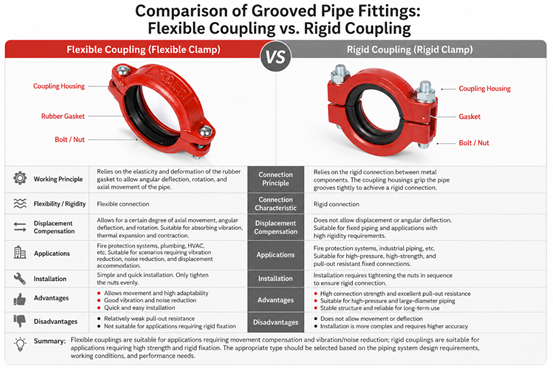
In the complex world of waterworks infrastructure, one of the most frequent—and expensive—procurement errors in 2026 is the failure to distinguish between rigid and flexible designs. While both fall under the broad category of the grooved pipe fitting, they serve diametrically opposite mechanical purposes. Many buyers, focused solely on pipe diameter and material grade, overlook the internal housing geometry that dictates how a system reacts to physical stress.
A rigid coupling is designed to lock the pipe ends together in a grip that mimics a welded joint, providing structural stiffness and alignment. In contrast, a true flexible coupling features a unique internal key section that is slightly wider than the pipe groove. This engineering nuance allows for controlled axial movement, rotation, and angular deflection. In 2026, as infrastructure projects become more complex, the "flex" in a ductile iron coupling is no longer an optional feature—it is a mechanical necessity for systems subject to thermal expansion, ground settling, or equipment vibration.
When a buyer mistakenly installs rigid couplings in a system that requires flexibility—such as a long-distance municipal water line or a high-rise HVAC loop—the results are often catastrophic. Without the ability to absorb movement, the piping system becomes brittle. Thermal expansion leads to "bowing" of the pipes, which puts immense stress on hangers and brackets. Eventually, the grooved pipe fitting itself or the pipe wall will succumb to stress fractures, leading to high-pressure leaks and costly emergency repairs.
With 44 years of expertise (since 1982), our factory has mastered the precision casting required to produce high-performance flexible joints. We ensure that our FM/UL certified flexible couplings provide the exact degree of deflection specified in your blueprints. By sourcing from a pipe fitting factory that employs over 4,000 employees and utilizes automated DISA production lines, you eliminate the risk of "tolerance creep" that often plagues smaller suppliers. Whether you are sourcing from our China headquarters or our Romania production base, we help you identify the correct coupling type to ensure your waterworks infrastructure is built for resilience, not just rigidity.
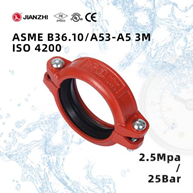
As we navigate the high-stakes engineering requirements of 2026, a critical mistake many buyers make is failing to account for the rising pressure demands of modern waterworks infrastructure. Historically, "standard" duty was often sufficient, but the current global shift toward taller skyscrapers and more efficient industrial processes has pushed system pressures to new heights. Choosing a grooved pipe fitting based on outdated 1.0 MPa or 1.6 MPa specifications can lead to catastrophic system failure when faced with the realities of 2026 infrastructure.
In 2026, the industry has widely adopted the 2.5 MPa standard as the baseline for high-rise fire protection and municipal mainlines. This isn't just about the average operating pressure; it’s about the "Safety Margin." Systems frequently experience surge pressures or "water hammer" effects that momentarily spike well above the nominal rating. A ductile iron flexible coupling that is only rated for 1.6 MPa lacks the structural integrity to absorb these shocks repeatedly. Over time, these spikes cause fatigue in the casting, eventually leading to a burst joint that can cause millions in water damage.
Achieving a reliable 2.5 MPa rating while maintaining the "flex" of a flexible coupling requires superior metallurgical control—a strength our pipe fitting factory has cultivated over 44 years of experience (since 1982). Many budget-tier suppliers attempt to reach high-pressure ratings by simply making the fitting thicker and heavier, which often makes the iron brittle. Our process utilizes advanced DISA production lines and high-grade ductile iron to ensure that every FM/UL certified fitting maintains the perfect balance of tensile strength and ductility.
Smart buyers now recognize that the cost difference between a standard fitting and a high-pressure rated one is negligible compared to the cost of a system-wide failure. By partnering with a global manufacturer that operates with over 4,000 employees and maintains a dual-base strategy (China and Romania), you ensure that your inventory meets the 2.5 MPa standard required for the most demanding 2026 projects. Don't let an underestimated pressure spec become the "weakest link" in your supply chain.
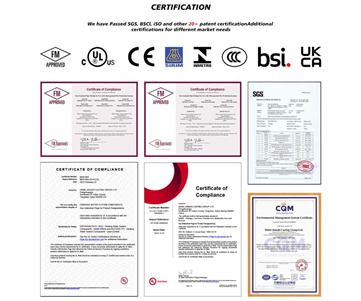
In the competitive bidding environment of 2026, the temptation to minimize upfront costs by selecting uncertified grooved pipe fittings is a trap that many buyers fall into. However, in the high-stakes world of waterworks infrastructure, prioritizing a low unit price over recognized quality marks like FM (Factory Mutual) and UL (Underwriters Laboratories) is often the most expensive mistake a procurement officer can make.
Choosing a flexible coupling based solely on the lowest quote frequently leads to "hidden" costs that far exceed any initial savings. In 2026, global building codes and insurance policies have become incredibly stringent. If a non-certified fitting is discovered during a project audit, the result is often an immediate work stoppage, mandatory replacement of all installed units, and massive project delays. Even worse, should a failure occur, insurance providers routinely deny claims if the waterworks infrastructure was built using components that lack the specific FM/UL certifications required for high-pressure fire protection or municipal service.
While many factories claim to "meet" standards, there is a significant "Certification Gap" between a factory that simply follows a guideline and one that undergoes rigorous, third-party testing. Our pipe fitting factory, with its 44-year legacy (established in 1982), maintains a comprehensive portfolio of global approvals, including FM, UL, CE, TSE, and ABNT. These certifications are a testament to our metallurgical consistency and our ability to meet the 2.5 MPa standards across millions of production units. With over 4,000 employees and a commitment to quality, we ensure that every ductile iron coupling is not just a piece of metal, but a globally recognized asset.
Beyond the physical stamp, modern buyers must also consider transparency. In 2026, we have integrated "Digital Twin" technology into our production. By scanning a laser-etched QR code on our FM/UL certified fittings, buyers can instantly access material heat numbers and testing logs. This level of accountability is something budget-tier suppliers simply cannot offer. When you source from our China or Romania production bases, you aren't just buying a grooved pipe fitting; you are buying the peace of mind that comes from 44 years of certified excellence.
In the trade climate of 2026, the "sticker price" of a grooved pipe fitting is often a secondary concern compared to its final landed cost. A significant mistake global buyers make is overlooking the complex web of anti-dumping duties, countervailing measures, and the newly implemented CBAM (Carbon Border Adjustment Mechanism) taxes. For a procurement manager in Europe, North America, or Latin America, a "cheap" quote from a standalone factory can quickly transform into a financial liability once it crosses the border.
Currently, many jurisdictions have imposed aggressive anti-dumping penalties on malleable iron and ductile iron products originating from single-source regions to protect local industries. These duties can range from 15% to over 50%, instantly erasing any initial cost advantage. Buyers who fail to audit the "country of origin" strategy of their suppliers often find themselves stuck with unexpected customs bills that derail their waterworks infrastructure budgets. In 2026, sourcing intelligence is just as important as engineering specifications.
To mitigate these geopolitical risks, our group has pioneered a dual-base production strategy. By operating a major production base in Romania alongside our high-volume Chinese facilities, we offer a unique "Tariff Shield" for our partners. Fittings produced in our Romanian facility carry EU-origin status, making them 100% exempt from anti-dumping duties targeting Asian imports. This allows our customers to maintain the high-quality standards of a 44-year-old legacy manufacturer while benefiting from local trade agreements and reduced shipping times within the EMEA region.
Furthermore, 2026 marks the full implementation of CBAM, where importers must pay for the carbon embedded in iron and steel products. Sourcing from our pipe fitting factory ensures compliance with these green mandates. With 4,000+ employees and a focus on automated, energy-efficient DISA lines, we provide the verified carbon data needed to satisfy 2026’s "Green Tariff" requirements. Whether you are navigating the US market or the EU’s regulatory landscape, our FM/UL certified products, combined with our strategic China and Romania footprint, ensure your flexible coupling procurement remains duty-optimized and future-proof.
In the high-stakes world of waterworks infrastructure, the longevity of a grooved pipe fitting is determined by its surface defense as much as its internal metallurgy. A critical mistake often made by procurement teams in 2026 is treating coatings as a cosmetic choice rather than a functional engineering specification. Selecting the wrong finish for a specific environmental "Micro-Climate" is a guaranteed path to premature system failure, high-pressure leaks, and massive replacement costs.
Most budget-tier pipe fitting factories offer a standard painted or "black" finish. While our technical "black" coating is specifically formulated for industrial water and gas supply, many buyers mistakenly use standard-painted flexible couplings in highly corrosive environments like coastal regions, chemical processing plants, or underground wastewater facilities. In these settings, standard paint acts only as a temporary barrier. Once oxygen and moisture penetrate a single scratch, the oxidation process begins, leading to "pitting" that can compromise the 2.5 MPa (363 psi) pressure integrity of the ductile iron housing within months.
For 2026 projects demanding 50-year lifespans, ASTM A153 hot-dip galvanizing is the non-negotiable solution. Unlike a superficial spray-on coating, hot-dip galvanizing involves submerging the grooved pipe fitting in molten zinc, creating a metallurgical bond. This provides a "sacrificial" layer; even if the fitting is scratched during a rugged installation, the surrounding zinc will oxidize first, protecting the underlying iron. As a manufacturer with 44 years of experience (since 1982), we have refined our galvanizing process to ensure consistent thickness and coverage, meeting the most rigorous international standards for municipal water mainlines.
Environmental selection also extends to the base metal. Buyers often fail to consider whether malleable iron or ductile iron is better suited for their specific environment. While malleable iron remains the traditional choice for standard plumbing, ductile iron—with its superior tensile strength and impact resistance—is the modern 2026 standard for high-vibration industrial sites and seismic-prone zones. Selecting a flexible coupling cast from the wrong grade can lead to stress-corrosion cracking if the material isn't compatible with the fluid's chemical profile or the external soil's pH levels.
With over 4,000 employees and a global footprint, our factory doesn't just sell parts; we provide environmental solutions. We understand that a project in the humid coastal regions of the Mediterranean requires a different defense strategy than an indoor HVAC system in a dry climate. By leveraging our dual-base production strategy in China and Romania, we offer a full spectrum of coatings—from high-grade FM/UL certified galvanized finishes to specialized epoxy coatings for wastewater treatment.
In 2026, the cost of a "cheap" coating is far higher than the investment in a premium one. Trusting a factory with a 44-year legacy ensuresthat your waterworks infrastructure is shielded by the correct science, ensuring your grooved pipe fitting stays in the ground—and out of the repair log—for decades.
SAFER
PRODUCT INFO
ABOUT JIANZHI
TECH DATA
Contact Us
E-mail: sales1@jianzhi-fitting.com
Tel: +86 15822792427
Office In Tianjin:
Heping District, Tianjin, China.
Production Base 1:
Chifeng, Inner Mongolia, China.
Production Base 2:
Tangshan City, Hebei Province, China.
Production Base 3:
Schelei Street,Baicoi City,Prahova County,Romania