Jul. 31, 2026
Fire protection engineers face one recurring question on every project specification: malleable iron or ductile iron for the sprinkler fittings? Both materials are permitted under NFPA 13, both carry UL Listed and FM Approved marks — but their performance characteristics diverge sharply at the installation level. This guide breaks down the material science, the code requirements, and the real-world cost trade-offs so you can specify with confidence.
In a sprinkler system, the fitting is often the weakest link. Threaded connections concentrate stress at every elbow, tee, and coupling. If the material lacks the right balance of strength and ductility, failures propagate from the threads outward.
Malleable iron absorbs stress through its microstructure. The annealing process transforms brittle white iron into a ferritic matrix with dispersed graphite nodules, giving it tensile strength up to 400 MPa with measurable elongation before fracture.
Ductile iron is stronger on paper — tensile ratings exceed 420 MPa — but its higher hardness makes field threading more difficult and increases the risk of micro-cracks during installation.
For the specifier, the decision comes down to three variables: pressure class, pipe diameter, and installation method.
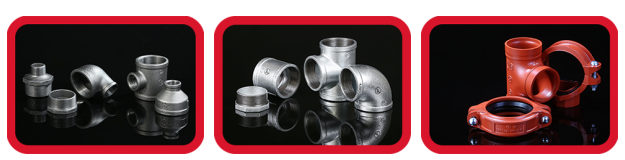
Jianzhi fire sprinkler pipe fittings are manufactured to EN10242 and certified under both UL and FM — the two marks every North American and global fire protection project demands.
Parameter | Specification |
Standard | EN10242 (ISO 49 harmonized) |
Material | Malleable iron W400-05 / HDG |
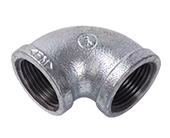
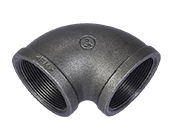
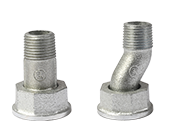
Product Types | Elbows (45°/90°), Tees (equal/reducing), Crosses, Unions, Couplings, Bushings, Caps, Plugs, Nipples |
Thread Types | BSPT (EN10226) / NPT (ASME B1.20.1) |
Pressure Class | Class 150 / Class 300 |
Size Range | 1/8 to 6 |
Finish Options | Black, Hot-Dip Galvanized |
Certifications | UL Listed, FM Approved, ISO 9001, ABNT, SIRIM, CUL |
The two materials look similar on a spec sheet. On the jobsite, they behave very differently.
Property | Malleable Iron | Ductile Iron |
Tensile Strength | ~400 MPa | ~420 MPa+ |
Elongation | 5–10% | 2–3% |
Threadability | Excellent — annealed structure machines cleanly | Good — harder matrix requires sharp tooling |
Corrosion Resistance | Moderate (galvanized option available) | Moderate |
Cost | Lower | 15–25% higher |
NFPA 13 Status | Explicitly permitted for threaded fittings | Permitted; more common in grooved systems |
Why is malleable iron preferred for fire sprinkler systems?
The short answer: thread integrity.
Malleable iron's annealing process creates a microstructure that cuts clean threads without brittle fracture. When a Class 150 threaded elbow or Class 300 galvanized tee is torqued onto NPT or BSPT pipe, the thread flanks deform slightly — creating a metal-to-metal seal that PTFE tape or pipe dope reinforces. Ductile iron, by contrast, resists this micro-deformation. The result: more reliance on sealant, higher leak risk at elevated pressures, and a narrower margin for installation error.
For the 1/2 to 2 threaded fittings that dominate fire sprinkler branch lines, malleable iron is the industry standard for a reason.
Can I use ductile iron fittings instead of malleable iron for fire protection?
NFPA 13 does not prohibit ductile iron, but requires every fitting to be listed for fire protection service. The key distinction:
Threaded fittings ≤2: NFPA 13 Table A.6.4.1 references ASME B16.3 for malleable iron threaded fittings. Ductile iron threaded fittings are not covered by the same standard. Substitution requires AHJ (Authority Having Jurisdiction) approval — never assume it.
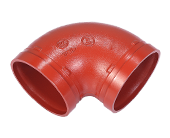
Grooved fittings: This is where ductile iron dominates. ASTM A536 ductile iron grooved couplings and fittings handle larger diameters (2.5+) and higher system pressures with lower weight than malleable alternatives.
The practical rule: threaded → malleable iron; grooved → ductile iron. Mixing them without engineering review risks a code rejection.
NFPA 13 is not a product standard — it is an installation standard. It defers material qualification to the listing agencies: UL and FM.
UL Listed confirms the fitting has passed laboratory fire-safety and pressure testing per UL 213 and UL 852. A UL Listed malleable iron fitting is tested to 2,000+ psi hydrostatic pressure with zero rupture.
FM Approved adds ongoing factory surveillance — unannounced audits verifying that production quality matches the tested sample, batch after batch.
Class 150 vs Class 300: Most NFPA 13 wet and dry sprinkler systems specify Class 150 fittings rated to 300 psi working pressure. Class 300 (rated to 2,000 psi) is reserved for high-rise standpipes and high-pressure zones.
Verification step: Before accepting any shipment, search the supplier's UL file number at UL Product iQ and their FM ID in the FM Approvals Guide. If the listing is expired or the company name doesn't match, reject the lot.
When a 40-story residential tower needs 15,000 black malleable iron elbows and tees by next month, supply chain reliability matters as much as material specs.
44+ years of production experience — the metallurgical expertise to manufacture consistent EN10242 threaded fittings across millions of units per month.
400,000 m² manufacturing facility — China's largest cast iron pipe fitting factory, absorbing demand spikes without lead-time blowouts.
Full fire-protection certification suite: UL Listed, FM Approved, ISO 9001, ABNT, SIRIM, CUL. One supplier covers North America, Brazil, Malaysia, and Canada under a single quality system.
BSPT and NPT threaded fittings from one source — no need to split orders when your project spans regions with different thread standards.
For EPC contractors managing multi-jurisdiction fire protection scopes, that means one audit, one supplier, zero certification gaps.
Use this decision tree for every fire sprinkler fitting specification:
Threaded connection, ≤2 pipe → malleable iron, Class 150 or 300, UL/FM listed
Grooved connection, 2.5 + pipe → ductile iron per ASTM A536, UL/FM listed
Galvanized required → specify hot-dip galvanized malleable iron (never electroplated)
Gas or dry system → black malleable iron (galvanized zinc can flake and clog nozzles)
International project → verify local certification equivalence (ABNT for Brazil, SIRIM for Malaysia, CUL for Canada)
Every specification starts with verification. Check UL Product iQ and FM Approvals Guide before you sign the PO.
For EPC Contractors & Fire Protection Specifiers Download MTRs (Material Test Reports), full UL/FM certificate packs, and EN10242 compliance documentation for NFPA 13 submittal packages — covering Class 150 and Class 300 fittings from 1/8 to 6 .
For Wholesalers & Distributors Request Jianzhi's Fire Protection Volume Price Sheet — full range of threaded malleable iron fittings (elbows, tees, crosses, couplings, unions, caps, plugs, nipples), one supplier, six certifications.
SAFER
PRODUCT INFO
ABOUT JIANZHI
TECH DATA
Contact Us
E-mail: sales1@jianzhi-fitting.com
Tel: +86 15822792427
Office In Tianjin:
Heping District, Tianjin, China.
Production Base 1:
Chifeng, Inner Mongolia, China.
Production Base 2:
Tangshan City, Hebei Province, China.
Production Base 3:
Schelei Street,Baicoi City,Prahova County,Romania